

Folk Crafts & Rhythms.
Folk Crafts & Rhythms, led by Crane Creatives and made possible by The National Lottery
Heritage Fund, thanks to National Lottery players, celebrates and preserves
the rich cultural heritage of Eastern European communities in the UK.
Across five days at the Guildhall Museum, visitors were invited to discover, experience and take part in traditional folk customs from Poland, Latvia, Lithuania, Ukraine and Slovakia
through hands-on crafts, music, dance and storytelling, while exploring the stories and traditions that continue to shape communities today and their sense of belonging here in the UK.


As part of this project, we recorded oral history interviews with members of these communities, capturing their memories, traditions and experiences of life in the UK.
These stories have been brought together in our online oral history exhibition
Oral history exhibition "Seasons of Belonging".
Visit our online oral history exhibition, "Seasons of Belonging", and discover the personal stories behind the traditions.
Through interviews with people from Ukrainian, Latvian, Lithuanian, Polish and Slovak communities, you'll explore memories of family customs, seasonal celebrations and the ways cultural heritage continues to be preserved and passed on in the UK today.
Folk Crafts & Rhythms Highlights
We welcomed visitors for a joyful celebration of Polish folk traditions led by Karolina Węgrzyn.
Throughout the day, visitors discovered the stories behind traditional Polish music and learnt about the customs and symbolism of wedding dances that have brought communities together for generations. Families were invited to join in with lively folk dances and traditional games, experiencing first-hand the warmth and hospitality
at the heart of Polish celebrations.
Alongside the music and dancing, participants explored the colourful tradition of Polish wycinanki (paper cut art), creating their own decorative designs inspired by traditional folk motifs such as roosters, flowers and paired figures representing love, family and prosperity. Through hands-on making, visitors discovered how these vibrant paper decorations have brightened Polish homes and celebrations for generations.
Throughout the day, we invited visitors to think beyond the activities and reflect on their own lives and experiences. What traditions would you like to pass on? What makes somewhere feel like home? Is it important to learn about different traditions? Why? As stories were shared around the craft tables and dance floor, these conversations became just as important as the workshops themselves.


.jpg)
.jpg)
"When I lived in Poland, I never really paid much attention to what these traditional crafts or symbols meant. Like many young people, I was more interested in modern culture and everyday life. Since moving to the UK, I've started looking at them differently. They remind me where I come from. It's strange how moving away from home makes you appreciate your heritage in a completely new way."
"We were invited to dance, make traditional crafts, listen to stories and meet people who carry these traditions today. It felt welcoming, interactive and different from a typical museum visit."
"I came here today with my daughter. I just thought it was really nice to see something from our culture happening in a local museum. I'm not massively into folk traditions myself, but I wanted her to see that this is part of where we come from. It's nice that she can experience it here in Leicester."


Spring traditions took centre stage as visitors explored
the beautiful art of Slovak Easter egg decoration.
Participants discovered the meanings behind the intricate patterns and vibrant colours that have been passed down through generations,
while learning about the customs and celebrations that mark Easter across Slovakia.
Guided by Andrea Ruttkayova, participants decorated their own eggs using traditional techniques and enjoyed hearing stories about
the importance of this cherished folk tradition.


"I'm Lithuanian and I actually came just to decorate an egg because it's something we used to do as children, usually using onion skins. I think Estonians have similar traditions too. To be honest, I was curious to see how people from outside the Baltics would approach it. In the end, I made a Slovak egg using the wax technique, which was completely different. It was really enjoyable, and hearing Andrea explain the stories behind the patterns made it even more special."


While some adults enjoyed learning the traditional Slovak wax-resist technique for decorating Easter eggs, many children and families chose to explore a Baltic tradition, decorating eggs with leaves, flowers and onion skins before boiling them to reveal beautiful natural patterns.
While waiting for the eggs to cook, our volunteer Sigita shared some traditional Baltic superstitions.
One favourite was:
"You must swing on Easter Sunday. If you don't, the mosquitoes will bite you all summer!"To make sure everyone had good luck, Sigita had even prepared swings, and visitors of all ages happily took turns swinging.
Inspired by this, the children began inventing their own superstitions. One of our favourites was:
"If you don't eat your Easter egg before sunset, a cheeky bunny will hide your shoes until next Easter!"
"I came because I enjoy learning about different cultures. What surprised me most was how many similarities there are between Easter traditions across Europe. The techniques might be different, but using natural materials, hearing the superstitions and the explanations behind why things are done in a certain way all felt very familiar. There's a little bit of magic in every tradition, but what really comes through is how important it is to pass these traditions on to the next generation."

"It was great fun volunteering at the workshop. Winning first prize in the Easter egg competition and exhibition was a lovely bonus, and it made the whole experience even more memorable."

The Guildhall Museum in Leicester came alive with the sounds of traditional Ukrainian music performed by Iryna Muha. Visitors enjoyed intimate live performances on traditional instruments, learning about the stories and rhythms behind the melodies.
Many guests took part in hands-on sessions, picking up a few notes and joining in to make music together. Alongside the music, families also explored Motanka doll-making, discovering this beautiful folk art tradition in a relaxed, creative atmosphere.


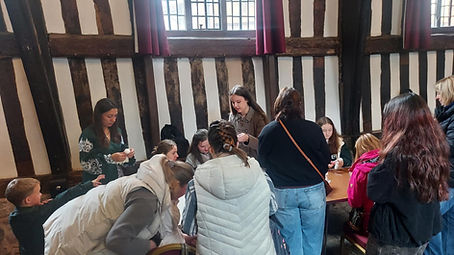

The following month, the Guildhall hosted a vibrant celebration of Latvian culture featuring the Leicester Latvian Folk Dance Group Rokraksts.
The group performed energetic and colourful traditional dances in striking folk costumes, delighting visitors with their artistry.
Guests were invited to learn a few steps and join in, filling the museum with rhythm and joy.
Throughout the day, participants also explored
traditional Latvian belt-making, connecting with Latvia’s rich cultural heritage through hands-on creative workshops.
.jpeg)


“I came especially to hear the Ukrainian folk musicians, and I was amazed by the story of the hurdy-gurdy. I didn’t know that during the years of russification, this instrument was banned in Ukraine and only survived through diaspora communities abroad. To hear it played here, in Leicester, felt very powerful. Music carries memories, and today reminded me how important it is to protect cultural traditions that have been threatened or silenced.”
“Many of my students are from Eastern Europe, so I came to learn more about their heritage. The workshops gave me a much deeper understanding of their traditions, especially how music, crafts and storytelling shape identity. It will help me support my students better in the classroom. It was also lovely to see how confident they were when they recognised aspects of their own cultures being celebrated so openly.”
“Making motanka dolls today made me feel proud. This is something my mother taught me when I was a child in Ukraine, and to share it here—with people who had never seen this craft before—felt meaningful. I was able to explain the symbolism, the fabrics, and why the dolls have no faces. For me, it is a connection to home. Seeing others interested in our traditions, during such a difficult time for Ukrainians, gave me hope and strength.”


“I rehearse regularly with the Latvian dance group in Leicester, but performing for a wider audience and teaching the basic steps to new people meant so much to us. Folk dancing is joyful, but it’s also a living connection to our ancestors. Seeing people of all ages try it for the first time—and enjoy it—reminded me why we keep these traditions alive.”
“I’m visiting my cousin in Melton from Australia and saw this event advertised. My grandfather was Latvian, but I grew up knowing very little about the culture. Joining the dance workshop was emotional for me—it felt like discovering a part of my family history that I never had access to.”


Each season is linked to a celebration that honours nature, and straw mobiles have long been part of the preparations for these festivities.
Hung on strings, these delicate creations would sway gently in
the warm air, casting mesmerising shadow patterns around them.
In folklore, straw mobiles were believed to absorb negative energy and protect the people nearby, acting as guardians of harmony.
After the celebrations, the mobiles were burned to ensure that any captured negativity or evil spirits could not escape, completing their role as purifiers and protectors.

Straw Mobiles
We made straw mobiles as part of our Folk Crafts & Rhythms project, inspired by a craft tradition with deep roots in Eastern Europe.
Similar straw mobiles are found across the Baltic countries, Poland, and Ukraine, where they are known by different names: sodas in Lithuania, puzuris in Latvia, õlgmobile or õlekroon in Estonia, pająk in Polish, and павук in Ukrainian—both the Polish and Ukrainian terms translating to “spider.”
For centuries, elders in these regions have created straw mobiles as a way to bring harmony and inner peace into the home. The making process is often described as self-organising and calming, encouraging focus, mindfulness, and a deeper connection to the present moment.
These mobiles are based on a symbolic structure. The vertical axis represents the flow of past, present, and future, while the horizontal axis points to the four directions: North, South, East, and West. At the very centre lies the now—the present moment.
One of the most common traditional designs includes twelve smaller elements, symbolising the months of the year, coming together to form a complete cycle and reflecting the rhythms of time and nature.

"It was wonderful to share this craft with museum attendees today. I loved making straw mobiles with my godmother when I was a child, and returning to this practice brought back many treasured memories.
Sharing those memories with people in Leicester felt especially meaningful.
In earlier times, before television, long dark evenings were often spent by candlelight. Straw mobiles would gently sway in the warm air, casting moving shadows on the walls—beautiful, ever-changing ornaments made of light and motion. In Latvia, we called them puzuri, and I can clearly see why in Poland and Ukraine they are known as “spiders”: in the shadows, the straw shapes really do resemble spider legs dancing.
While teaching local participants how to make puzuri, we also enjoyed a rich exchange of knowledge about British folk traditions. I was particularly fascinated to learn about apple carving, and I’m very curious to try it out."

All digital assets produced through Folk Crafts & Rhythms are openly licensed under the Creative Commons Attribution 4.0 International Licence (CC BY 4.0), allowing reuse with appropriate credit.
Free Teaching Resource – Year 3 Lesson Plan
Bring the stories, traditions and creativity of Folk Crafts & Rhythms into your classroom.
Developed for Year 3 (Key Stage 2), this free lesson plan uses the Seasons of Belonging online oral history exhibition and the Folk Crafts & Rhythms project to help pupils explore culture, identity, belonging and seasonal traditions through art, storytelling, discussion and creativity.
The resource can be used as:
a one-off cultural learning lesson
an Art & Design project
a creative writing stimulus
a PSHE lesson about identity and belonging
a Geography lesson comparing places and cultures
a starting point for a school display or mini exhibition
Through practical activities and thoughtful discussion, pupils are encouraged to explore the traditions that shape communities, reflect on their own family experiences, and discover the similarities that connect cultures across Europe.
Download the free Year 3 Lesson Plan below and start exploring the seasons, traditions and stories that help us all feel a sense of belonging.
Year 3 Lesson Plan
Supporting Materials for the Lesson Plan
Belonging: Voices of Eastern Europe in the UK
We invite Eastern Europeans in the UK to take part in friendly 20 – 30 minute
conversations, either on site or online.
What we’re curious about:
-
Journeys to the UK and first impressions
-
Traditions kept alive — crafts, music, dance, language
-
Passing culture to the next generation
-
Life in UK and contributions to community life
Why take part?
Our voices matter. Too often, stories about Eastern Europeans are told by others — but we believe in empowering you to tell your own story.
These conversations will be preserved in an archive so that the experiences, traditions,
and contributions of Eastern Europeans in the UK are not lost.
By giving just 20 minutes of your time, you help ensure that our history is remembered and celebrated for future generations.


Enquiries: Liga — ligacranecreatives@gmail.com